|
|
|
|



|
|
In a separate study, scientists
monitored tiny "microearthquakes" along a
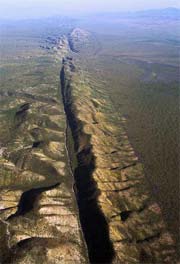
section of the notorious San Andreas Fault, which runs from Mexico to San
Francisco, to create images of what the inside of the fault looks like. The
results show that the fault zone has four secondary faults that may connect
to a deeper and older part of the fault system. The fault zone is also
composed of multiple cracks or possibly pockets of fluid. "[Our research] suggests a complex
fault zone where stresses could be distributed in complicated ways,"
said Andres Chavarria, a senior graduate student in
seismology at The reports are published in the
December 5 and December 12 issues of the research journal Science. Earthquake
Interactions A magnitude 7.9 earthquake occurred
in a remote part of The event prompted some experts to
speculate that such a chain reaction could happen in the The USGS researchers studied the
Sierra Madre, Cucamonga, San Andreas, and The Sierra Madre-Cucamonga system
is a "thrust" fault; the sides are being pushed towards each other.
The San Andreas and Using the geometry of the faults
in the region, physics of the earthquake slip and data from previous
ruptures, the researchers created computer models for future earthquakes. The
results show that while the rupture of a thrust fault system is unlikely to
trigger rupture of the strike-slip faults, it could happen the other way
around. "Under certain, very rare
circumstances, a large earthquake on the northern San Jacinto fault near
Riverside and San Bernardino could trigger a cascading rupture of the Sierra
Madre-Cucamonga fault system, which could have a total magnitude of 7.5 to
7.8," said Greg Anderson, a geophysicist formerly with the USGS and now
working for UNAVCO, Inc. in Boulder, Colorado. An earthquake of magnitude 7.5 to
7.8 is considered "major" (between "strong" and
"great") and could cause severe damage to the "The shaking and damage from
such an event could possibly exceed that of the 'Big One' on the "So we know that at most a
small fraction of the large earthquakes on the The The The hole, known as the By studying readings from a chain
of 32 seismometers installed in the hole, Chavarria
and colleagues determined that the San Andreas Fault, which produced the
devastating 1906 San Francisco earthquake, is perhaps more complex than
previously thought. "Using very unique recordings
of microearthquakes in the pilot hole, we have been
able to obtain images of the The scientists created those
images by tracing the complex paths that earthquake waves took after
scattering off the possible underground structures. "Going deeper in the earth we
are closer to the source of earthquakes and therefore we can understand these
phenomena better," said Chavarria. Next summer, scientists will
extend the drill hole into the fault zone to construct a major earthquake
"observatory." "This knowledge will allow
seismologists to better determine which processes happen right before an
earthquake starts," said Chavarria. "This
will help us to better understand the risks associated [with] earthquakes as
well to better prepare for such events." |